
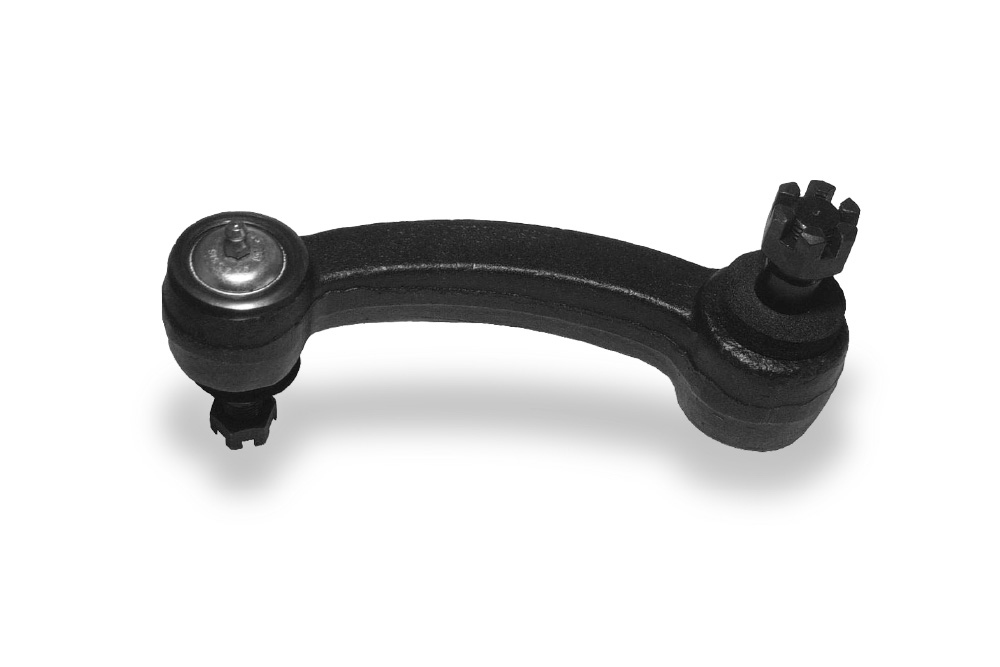
Idler Arms
Suspensia idler arms provide the support and stability critical to parallelogram steering systems.
Our complete assemblies include premium bushings and all necessary hardware for professional installation.
Overview
The idler arm assists the pitman arm by supporting the steering linkage as it moves in the direction controlled by the steering gear. The idler arm consists of a bracket, an arm that connects the bracket to the center link of the steering linkage, and an internal pivot bearing.
The idler arm is used on vehicles with conventional suspension systems and parallelogram steering. This type of suspension and steering arrangement is used on virtually all rear-wheel-drive vehicles and many light trucks.
Key Features
- Complete assemblies
- Premium bushings
- Heavy-duty construction
- Corrosion-resistant finish
- OE fit specifications

Frequently Asked Questions
What is an idler arm and what does it do?
The idler arm supports and guides the steering linkage on the opposite side of the pitman arm. It consists of a bracket, a connecting arm that links the bracket to the center link of the steering linkage, and an internal pivot bearing. As the pitman arm pushes and pulls the center link left and right, the idler arm keeps it level and moving in the correct plane — maintaining the geometry of the entire parallelogram steering system. Without a functioning idler arm, that geometry breaks down and steering becomes loose and unpredictable.
What's the difference between an idler arm and a pitman arm?
The pitman arm is attached to the steering gear output shaft and is the primary driver of the center link — it’s what actually moves when you turn the steering wheel. The idler arm mirrors the pitman arm on the opposite side of the vehicle, providing support and keeping the center link level and parallel to the ground. The pitman arm drives; the idler arm guides.
How do I know if my idler arm needs to be replaced?
Common symptoms include a loose or wandering steering feel, the vehicle drifting to one side, excessive play in the steering wheel before the wheels respond, clunking sounds from the front end over bumps or during turns, and uneven tire wear. A technician can confirm idler arm wear by checking for vertical or lateral play in the center link with the vehicle raised.
Will a worn idler arm affect my wheel alignment?
Yes. The idler arm plays a direct role in maintaining the geometric relationship between the steering linkage components. When it wears and develops play, it allows the center link to shift position — throwing off toe alignment and causing rapid, uneven tire wear even on a vehicle that was recently aligned.
Do I need a wheel alignment after replacing an idler arm?
Yes, always. Idler arm replacement disturbs the steering geometry and toe setting. A professional wheel alignment must be performed after installation to prevent accelerated tire wear and restore precise steering feel.
Are Suspensia idler arms exact-fit replacements?
Yes. Suspensia idler arms are manufactured to be exact-fit for their specific applications through thorough development and verification — ensuring correct bracket dimensions, arm geometry, pivot bearing specs, and mounting hardware compatibility without modification.
Are Suspensia idler arms manufactured to OE standards?
Yes. All Suspensia components are produced in IATF 16949 certified facilities to meet or exceed original equipment standards.
What vehicles do Suspensia idler arms fit?
Suspensia idler arms cover a range of domestic and import rear-wheel-drive vehicles and light trucks that use parallelogram steering systems. Use the product catalog at suspensia.com with your year, make, and model to confirm the correct part for your application.
What type of vehicles use an idler arm?
Idler arms are found on vehicles with conventional parallelogram steering systems — a design used on virtually all rear-wheel-drive cars and many light trucks and SUVs. If your vehicle has a recirculating ball steering gear (as opposed to a rack-and-pinion system), it almost certainly has an idler arm as part of the steering linkage.
Should I replace the idler arm and pitman arm at the same time?
It’s worth considering. Both components are part of the same steering linkage system and wear at similar rates. If one is showing significant wear, the other is often not far behind. Replacing both during the same service visit saves labor and ensures the complete linkage is performing to spec.
Can I replace an idler arm myself?
Idler arm replacement is a moderate DIY job. It typically requires basic hand tools and, in some applications, a ball joint separator to disconnect the center link stud. The required post-repair wheel alignment must be done professionally, so factor that into your decision. Always torque the mounting hardware to the manufacturer’s specification.
What causes idler arms to wear out?
The internal pivot bearing is the primary wear point. Over time, road vibration, steering loads, and exposure to moisture and road debris degrade the bearing and introduce play into the linkage. Higher-mileage vehicles and those driven frequently on rough roads tend to wear idler arms faster.
What happens if I ignore a worn idler arm?
Continued driving with a worn idler arm leads to progressively worse steering precision, accelerating tire wear from misalignment, and added stress on the center link, tie rod ends, and pitman arm. In advanced cases, a completely failed idler arm can result in a sudden, significant loss of steering control — a serious safety risk.
Can a bad idler arm cause my vehicle to fail a safety inspection?
Yes. Measurable play in the steering linkage — including the idler arm — is typically a grounds for rejection in most states. If your steering feels loose or your front tires are wearing unevenly, have the idler arm inspected before your next inspection date.
Are Suspensia idler arms covered by a warranty?
Yes. Suspensia idler arms are backed by a warranty covering defects in materials and workmanship. The warranty is non-transferrable. Check your specific part listing or contact your distributor for applicable terms.